Note
Go to the end to download the full example code.
The Pusey-Barrett-Rudolph (PBR) Theorem
In this tutorial, we will explore the Pusey-Barrett-Rudolph (PBR) theorem
[1], a significant no-go theorem in the foundations
of quantum mechanics. We will describe the theorem’s core argument and then
use |toqito⟩ to verify the central mathematical property that
the theorem relies on.
The PBR theorem addresses a fundamental question: Is the quantum state (e.g., the wavefunction \(|\psi\rangle\)) a real, objective property of a single system (an ontic state), or does it merely represent our incomplete knowledge or information about some deeper underlying reality (an epistemic state)?
PBR Argument
The PBR theorem [1] argues against a broad class of epistemic models.
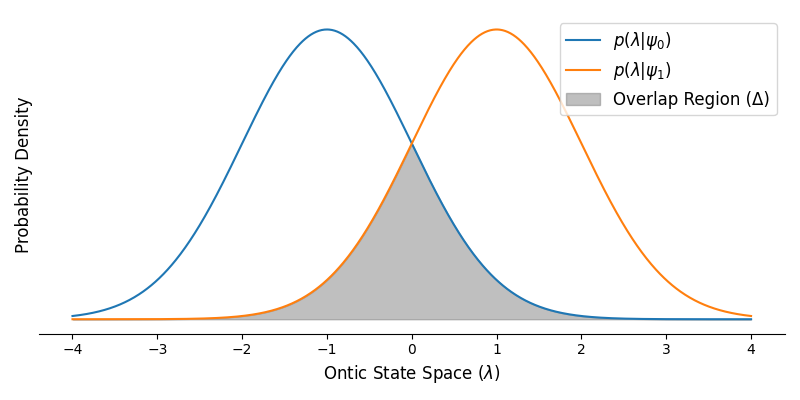
Epistemic Hypothesis: An epistemic model assumes there is a “real” physical state of the system, often denoted by \(\lambda\). The quantum state \(|\psi\rangle\) is then just a probability distribution over the possible values of \(\lambda\). A key implication is that the distributions for two different quantum states, say \(|\psi_0\rangle\) and \(|\psi_1\rangle\), could overlap. This means that for some underlying physical states \(\lambda\), the system could have been prepared in either \(|\psi_0\rangle\) or \(|\psi_1\rangle\).
We can visualize the overlap of these hypothetical probability distributions. To do this, we will create a simple illustrative plot. We are not assuming any specific physical model for \(\lambda\); the plot is purely a visual aid to make the concept of overlapping probability distributions concrete.
For this illustration, we represent the space of possible ontic states \(\lambda\) on the x-axis. We then choose two simple, overlapping normal (Gaussian) distributions to represent the hypothetical probability densities \(p(\lambda | \psi_0)\) and \(p(\lambda | \psi_1)\). The specific choice of Gaussian distributions is arbitrary; any pair of distinct, overlapping distributions would demonstrate the same essential feature.
45 import matplotlib.pyplot as plt
46 import numpy as np
47 from scipy.stats import norm
48
49 fig, ax = plt.subplots(figsize=(8, 4), dpi=100)
50 lambda_space = np.linspace(-4, 4, 1000)
51 dist_0 = norm(loc=-1, scale=1)
52 dist_1 = norm(loc=1, scale=1)
53 p_lambda_0 = dist_0.pdf(lambda_space)
54 p_lambda_1 = dist_1.pdf(lambda_space)
55 ax.plot(lambda_space, p_lambda_0, label=r"$p(\lambda | \psi_0)$")
56 ax.plot(lambda_space, p_lambda_1, label=r"$p(\lambda | \psi_1)$")
57 ax.fill_between(
58     lambda_space,
59     np.minimum(p_lambda_0, p_lambda_1),
60     color="gray",
61     alpha=0.5,
62     label="Overlap Region (Δ)",
63 )
64 ax.set_xlabel(r"Ontic State Space ($\lambda$)", fontsize=12)
65 ax.set_ylabel(r"Probability Density", fontsize=12)
66 ax.set_yticks([])
67 ax.legend(fontsize=12)
68 ax.spines["top"].set_visible(False)
69 ax.spines["right"].set_visible(False)
70 ax.spines["left"].set_visible(False)
71 plt.tight_layout()
Note
The shaded region \(\Delta\) represents the set of ontic states \(\lambda\) that are ambiguous—the system could have been prepared as \(|\psi_0\rangle\) or \(|\psi_1\rangle\). The PBR theorem shows that the existence of any such overlap (for any pair of distinct states) leads to a contradiction with quantum theory’s predictions. Figure adapted from the PBR paper [1].
Thought Experiment: The PBR paper [1] constructs a thought experiment to show this leads to a contradiction. Consider two non-orthogonal quantum states, for example:
\[|0\rangle \quad \text{and } \quad |+\rangle = \frac{1}{\sqrt{2}}(|0\rangle + |1\rangle)\]If their underlying reality distributions overlap, it’s possible to prepare a system where its true state \(\lambda\) is consistent with both preparations. Now, imagine we prepare two such systems independently. There is a non-zero chance that the combined physical state \((\lambda_1, \lambda_2)\) is compatible with any of the four possible quantum preparations:
\[|0\rangle \otimes |0\rangle, \quad |0\rangle \otimes |+\rangle, \text{ } |+\rangle \otimes |0\rangle, \quad |+\rangle \otimes |+\rangle\]Contradiction via Antidistinguishability: The crux of the theorem is to show that quantum mechanics allows for a special entangled measurement on the two systems. This measurement has a remarkable property: each of its possible outcomes is strictly forbidden (has zero probability) for at least one of the four product states.
This property is known as antidistinguishability. A set of states \(\{|\Psi_i\rangle\}\) is antidistinguishable if there exists a measurement with outcomes \(\{M_i\}\) such that \(\langle \Psi_i | M_i | \Psi_i \rangle = 0\) for all \(i\).
This leads to a contradiction:
The epistemic model predicts that sometimes the underlying reality \((\lambda_1, \lambda_2)\) is ambiguous.
In these cases, the measurement (which only depends on \(\lambda\)) must produce some outcome, say outcome \(k\).
But what if the state was actually prepared as \(|\Psi_k\rangle\)? Quantum mechanics says outcome \(k\) is impossible for this state.
This contradiction implies that the initial assumption—that the distributions for \(|0\rangle\) and \(|+\rangle\) overlap—must be false. The PBR theorem generalizes this to any pair of distinct quantum states. The conclusion is that, under the assumption of preparation independence, the quantum state must be ontic.
Verifying Antidistinguishability with |toqito⟩
We can now use |toqito⟩ to verify the key requirement for the PBR
theorem that the set of four states constructed from \(|0\rangle\)
and \(|+\rangle\) are indeed antidistinguishable.
137 import numpy as np
138
139 from toqito.matrices import standard_basis
140 from toqito.matrix_ops import tensor
141 from toqito.state_props import is_antidistinguishable
142
143 # Define the single-qubit states |0> and |+>.
144 e_0, e_1 = standard_basis(2)
145 state_0 = e_0
146 state_plus = (e_0 + e_1) / np.sqrt(2)
147
148 # Construct the four 2-qubit product states from the PBR paper's simple example.
149 psi_00 = tensor(state_0, state_0)
150 psi_0_plus = tensor(state_0, state_plus)
151 psi_plus_0 = tensor(state_plus, state_0)
152 psi_plus_plus = tensor(state_plus, state_plus)
153
154 pbr_states = [psi_00, psi_0_plus, psi_plus_0, psi_plus_plus]
155
156 # Check if this set of states is antidistinguishable.
157 is_ad = is_antidistinguishable(pbr_states)
158
159 print(f"Are the four PBR states antidistinguishable? {is_ad}")
Are the four PBR states antidistinguishable? True
The result confirms that there exists a measurement that can perfectly exclude each of the four states, providing the necessary ingredient for the PBR no-go theorem’s contradiction.
This result, derived from a solvable semidefinite program within
|toqito⟩’s state_exclusion() function supports the theorem’s
conclusion that the quantum state has a strong claim to being an
objective feature of reality.
General PBR States
The theorem holds for any pair of non-orthogonal states. The toqito library provides a function to generate the states from the more general proof in the PBR paper [1], which are defined by an angle \(\theta\).
For instance, we can generate a set of \(2^n\) states for some \(n\) and \(\theta\).
184 from toqito.states import pusey_barrett_rudolph
185
186 # Generate states for n=2 systems and theta = pi/3
187 general_pbr_states = pusey_barrett_rudolph(n=2, theta=np.pi / 3)
The inner product of the two base states is \(\cos(\theta)\). For these to be antidistinguishable, we need to check the condition from the paper. The theorem states that if \(2^{1/n} - 1 < \tan(\theta/2)\), a contradiction is obtained. For \(n=2\) and \(\theta=\pi/3\), we have \(\tan(\theta/2) = \tan(\pi/6) \approx 0.577\). The other side of the inequality is \(2^{1/2} - 1 \approx 0.414\). Since \(0.414 < 0.577\), the theorem applies and this set should be antidistinguishable.
197 is_ad_general = is_antidistinguishable(general_pbr_states)
198
199 print(f"\nAre the four general PBR states (n=2, theta=pi/3) antidistinguishable? {is_ad_general}")
Are the four general PBR states (n=2, theta=pi/3) antidistinguishable? True
References
Total running time of the script: (0 minutes 0.239 seconds)